No Tax on Tips Helpfor Texas owners
The practice is in Dallas. Texas has no personal income tax, so for a Texas worker the federal deduction is the whole income tax story. Owners still have sales tax and the May report to get right.
A call from Dallas, wherever you are in Texas
We meet on a video call, so it works from El Paso to Beaumont. Bring your W-2, 1099 or Form 4137, or your payroll setup if you own the business.
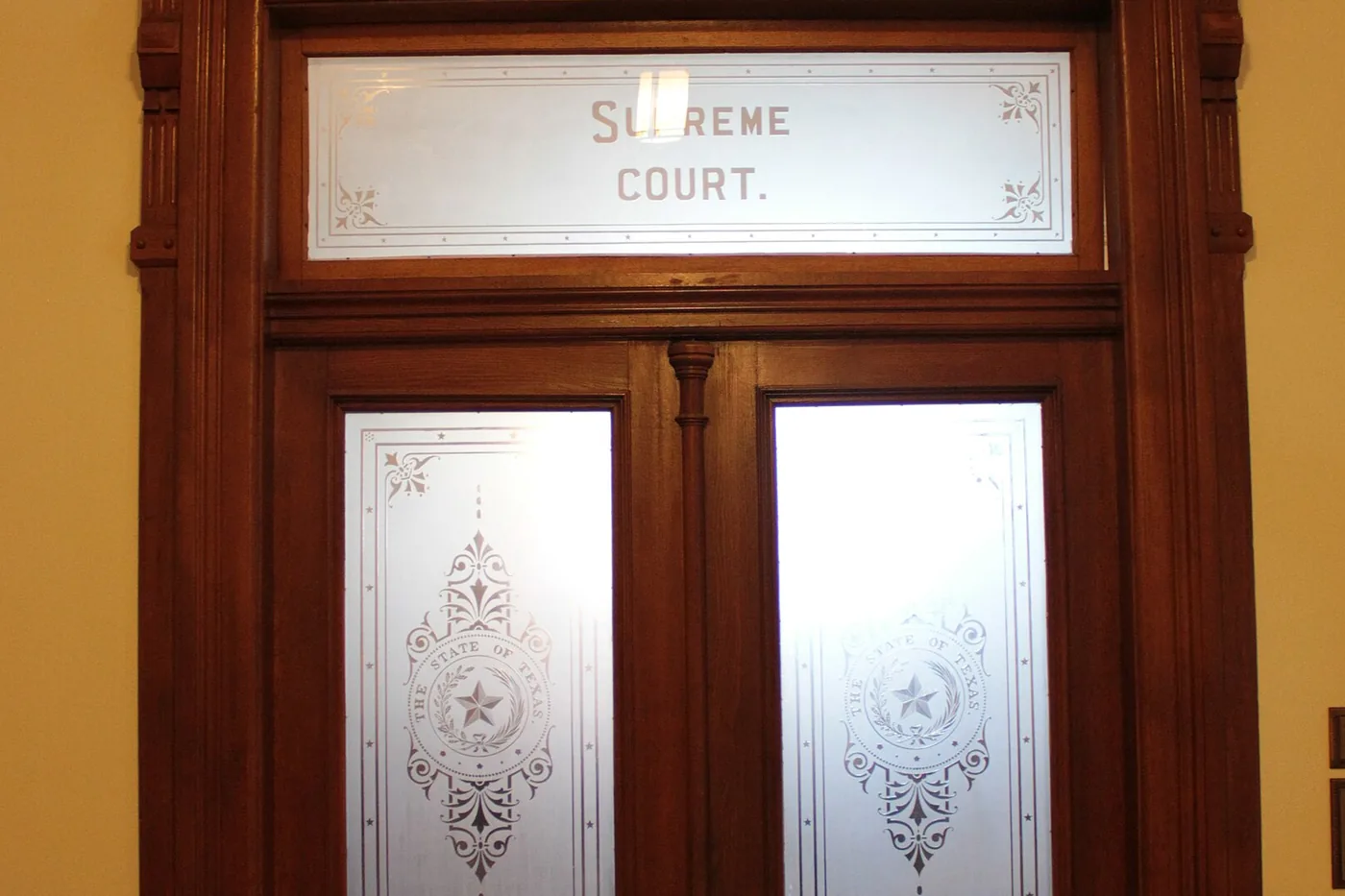
Photo: the Supreme Court doors inside the Texas State Capitol in Austin, by John Cummings, CC BY-SA 3.0.
No state income tax on your tips
Texas has no personal income tax. The tip deduction is a federal deduction, and there's no state income tax on the same tips.
Social Security and Medicare still come out. Your tips stay in federal gross income, and Schedule 1-A, Part II, is where you claim the qualified amount.
A worker in El Paso and a worker in Dallas use the same federal rules and the same IRS occupation list.
Tips and sales tax on the check
Ready-to-eat food is typically taxed in Texas even when the guest takes it away. A bakery item sold with no plate and no eating utensil is the usual exception, and the size of the item doesn't matter.
A tip the guest chose isn't part of the sales-tax price. Keep it on its own line.
A required extra of 20 percent or less stays out of sales tax when two things are true. The check labels it as a tip or gratuity, and the money goes only to the people who regularly serve. A required extra above 20 percent is part of the sales-tax price.
That Texas rule is separate from the federal rule. For the federal deduction, the question is whether the guest could change the charge or skip it. A charge can pass the Texas test and still miss the federal one, so we keep the two answers on two lines.
A meal the crew eats just before, during or just after a shift can stay outside sales tax when it's for the owner's convenience and the crew prepares or serves food. A meal paid with a Lone Star Card stays outside sales tax when the food benefit rules allow it. Neither meal is a qualified tip.
Alcohol has its own return
If you pour mixed drinks, the gross receipts tax is 6.7 percent. You pay it yourself. It isn't added to the guest's check as a separate charge.
The sales tax on those drinks is 8.25 percent. The permit holder may add it or include it in the price. Choose one of the two and use it every time. Keep alcohol sales apart from food in the books so both returns come from the same month-end.
A tip the guest chose stays outside the alcohol price. Keeping it on its own line keeps your wage forms and your sales tax return in agreement.
A gift card isn't taxed when you sell it. Tax is figured on the meal when the card pays for it. A coupon you aren't paid back for lowers the price the tax is figured on.
Look up the local rate for each location
The state's own share of sales tax is 6.25 percent of a taxable sale. Local pieces from the city, the county and transit together are capped at 2 percent, which makes 8.25 percent the most a guest pays.
The local rate depends on where the meal was sold, not where the company gets its mail. We use the Comptroller's rate locator for the street address, because local rates change.
Once the sales tax permit comes through, the Comptroller's letter tells you how often to file: monthly, quarterly or once a year. If you file monthly, each report is due on the 20th of the month after the sales. Quarterly filers report by the 20th of April, July, October and January. Yearly filers report by January 20. A due date on a Saturday, Sunday or state holiday shifts forward to the next open day. We check the holiday list for the year and give you the exact date.
Your company still has a May report
If the business is a company, the Comptroller expects a yearly franchise tax report. A sole owner with no company behind the business generally has no franchise report to file.
For 2026 and 2027, revenue of 2,650,000 dollars is the line where franchise tax drops to zero. At or below that line you owe no franchise tax, though a short information report can still be due.
When tax is owed, a business that sells food to the public is often on the retail rate, 0.375 percent. A business that is not retail or wholesale is on 0.75 percent. On the 2026 and 2027 reports, the compensation you subtract for one person can't go past 480,000 dollars. The 2024 and 2025 reports use their own no-tax line of 2,470,000 dollars.
May 15 is the due date. If the 15th falls on a Saturday, Sunday or holiday, you file on the next day the offices are open. A late report costs 50 dollars. Tax paid within 30 days after the due date carries a 5 percent penalty, and after 30 days the penalty is 10 percent. Interest begins once 61 days have passed, at the rate on the Comptroller's interest page for that quarter.
Skipping the short report can cost the company the right to sue or defend in a Texas court, and it can make the people who run the company responsible for some debts. We'd rather mention it now than have you learn it from a forfeiture letter.
What to bring from a Texas business
Your payroll setup and the year's W-2s. Whether your checks carry a required extra, and whether it's over 20 percent. Whether you pour alcohol, and whether the drink tax is added or included in the price.
If you're a company, whether this year's May report is filed, including the short one. If your books are behind, we catch them up first.
The federal limits are the same in Texas: up to $25,000 of qualified tips, shrinking above $150,000 of income, or $300,000 on a joint return.
Ask about your Texas business
The federal rules
Next: whether your tips are tax-free, and what still comes out of your paycheck.